

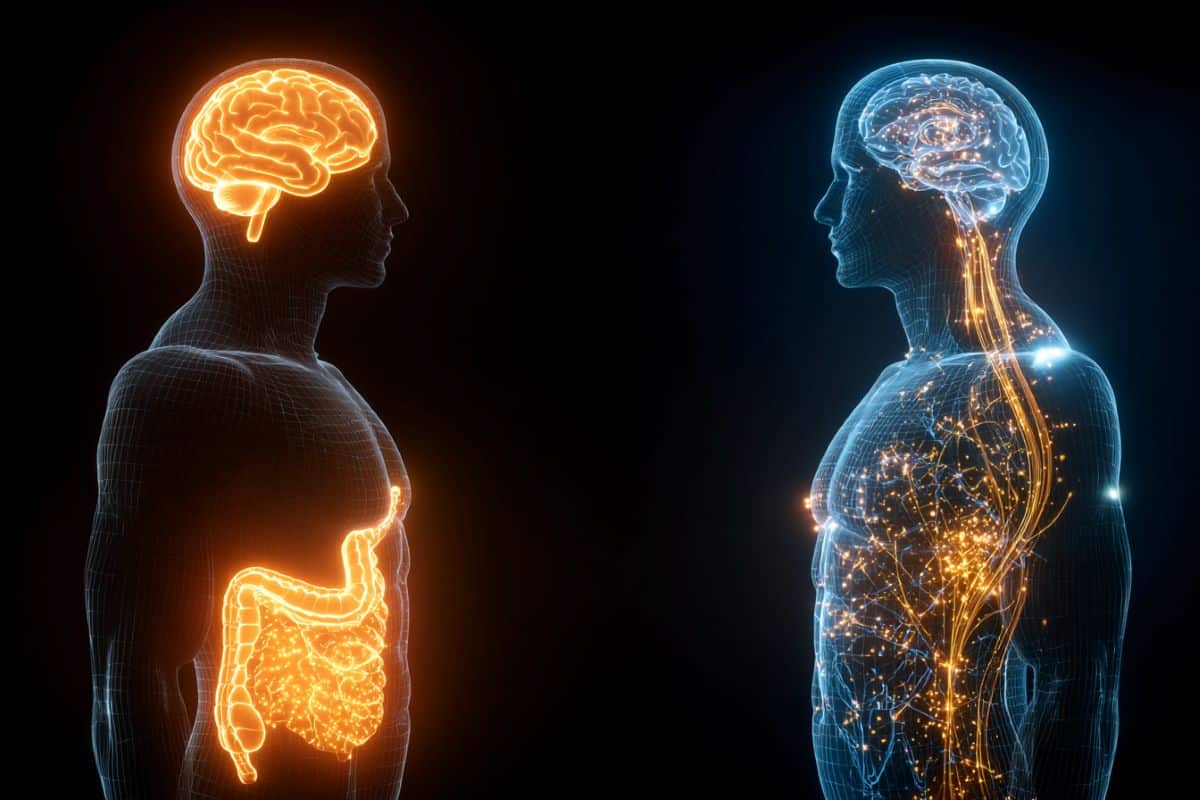
Abstract: A brand new longitudinal research reveals that the buildup of visceral fats, the “hidden” fats saved deep throughout the stomach cavity, is a major driver of mind atrophy and cognitive decline in late midlife.
By following 533 members for as much as 16 years utilizing repeated MRI scans, researchers discovered that sustained decrease ranges of visceral fats are related to the preservation of mind quantity and superior cognitive efficiency, unbiased of total weight reduction. The research identifies glucose management and insulin sensitivity because the organic bridge connecting stomach well being to mind longevity.
Key Analysis Findings
- Mind Construction Preservation: Decrease cumulative visceral fats over time was linked to larger complete mind quantity, better grey matter quantity, and a better Hippocampal Occupancy Rating—a crucial marker for reminiscence and ageing.
- Atrophy Markers: Elevated visceral fats ranges have been related to a sooner enlargement of the mind ventricles, a well-established signal of mind atrophy.
- The Glucose Hyperlink: The connection between stomach fats and mind ageing seems to be mediated primarily via glycemic steadiness. Fasting glucose and HbA1c ranges have been the one markers that constantly predicted structural mind adjustments over time.
- Specificity of Fats: These neuroprotective associations have been unique to visceral fats. No comparable relationship was discovered for subcutaneous fats (fats saved just below the pores and skin) or Physique Mass Index (BMI), suggesting that weight alone is an insensitive marker for mind well being.
- Early Intervention Payoff: Reductions in visceral fats throughout an preliminary 18-month dietary intervention predicted higher mind construction preservation 5 to 10 years later, no matter whether or not weight was regained.
Supply: Ben-Gurion College of the Negev
A groundbreaking long-term MRI research demonstrates that decrease accumulation of stomach fats (visceral fats), measured all through all the follow-up interval, is related to a major slowing of mind atrophy, preservation of key mind buildings, and higher cognitive efficiency in late midlife – unbiased of weight reduction.
The findings counsel that the connection between stomach fats and mind ageing is probably going mediated primarily via glucose management and insulin sensitivity. The research is the primary to hyperlink repeated MRI-based measurements of cumulative visceral fats with long-term trajectories of mind ageing and cognition.

The research’s findings have been revealed in Nature Communications.
The research is predicated on superior MRI imaging of the mind and stomach and consists of 533 ladies and men in late midlife who have been adopted for five to 16 years after taking part in 4 giant, long-term, managed dietary medical trials: DIRECT, CASCADE, CENTRAL, and DIRECT-PLUS, led by Prof. Iris Shai of Ben-Gurion College of the Negev, Dean of the Faculty of Sustainability at Reichman College, and an adjunct Professor at Harvard College. Throughout follow-up, repeated MRI measurements of visceral fats and mind buildings have been carried out, together with cognitive evaluation utilizing the MoCA check.
The findings present that decrease accumulation of visceral fats over time was related to larger MoCA scores, in addition to preservation of complete mind quantity, grey matter quantity, and the Hippocampal Occupancy Rating – a delicate marker of mind ageing and reminiscence. In parallel, a slowing within the enlargement of the mind ventricles was noticed, a course of that constitutes a well-established marker of mind atrophy.
Prof. Iris Shai: “The findings level to glucose management and discount of visceral stomach fats as measurable, modifiable, and achievable targets in midlife – with actual potential to gradual mind degeneration and cut back the chance of cognitive decline.”
The research was carried out at Ben-Gurion College of the Negev in collaboration with researchers from Harvard College, Leipzig College, and Tulane College.
A singular longitudinal follow-up, which included three mind MRI scans over 5 years in a subgroup of members, confirmed that persistently elevated ranges of visceral fats over time have been related to a sooner fee of mind quantity loss, notably within the hippocampus, and with accelerated enlargement of the mind ventricles. These associations weren’t noticed for subcutaneous fats, both superficial or deep, nor for physique mass index (BMI), highlighting the organic specificity of visceral fats.
Furthermore, the research discovered that reductions in visceral fats throughout an 18-month dietary intervention predicted higher preservation of mind buildings 5 and 10 years later, even after adjustment for weight reduction and different components. In different phrases, the discount in stomach fats itself – somewhat than weight reduction per se – was the issue predicting long-term mind outcomes.
The research signifies that the affiliation between visceral fats and mind ageing is mediated primarily via glycemic steadiness. Fasting glucose and HbA1c ranges have been the one markers that predicted the speed of structural mind change over time, whereas blood lipid markers or inflammatory markers didn’t present an identical affiliation.
These findings help the speculation that insulin resistance and continual dysregulation of glucose metabolism impair cerebral perfusion, compromise blood–mind barrier integrity and speed up degeneration of grey matter and the hippocampus.
Dr. Dafna Pachter, the research’s first writer, mentioned: “Weight alone just isn’t a delicate marker of the profound metabolic adjustments occurring within the physique. We discovered that even when weight reduction is modest, sustained reductions in visceral fats – as measured throughout all the interval – are related to preservation of mind construction and a slower fee of atrophy.”
Breakthrough Mind Research
That is the most important and longest research thus far linking cumulative publicity to visceral fats and mind measures, assessed longitudinally utilizing MRI, with the speed of mind ageing and cognitive operate. The mixing of repeated measurements of stomach fats, mind buildings, and cognition makes it attainable, for the primary time, to determine a particular metabolic goal – somewhat than normal weight problems – as a modifiable mind danger issue.
Funding: This research was funded by grants from the German Analysis Basis (DFG; LeiCeM, middle of Excellence) and the ERA-4-Well being initiative.
Key Questions Answered:
A: Based on this research, sure. The researchers discovered that visceral fats particularly—not BMI or subcutaneous fats—is the issue that predicts mind atrophy. This implies even “skinny” people with excessive inside stomach fats could face accelerated mind ageing.
A: It doubtless comes all the way down to insulin resistance and glucose dysregulation. Power mismanagement of blood sugar can impair blood circulation to the mind, compromise the blood-brain barrier, and set off the degeneration of grey matter and the hippocampus.
A: The research means that midlife is a crucial “modifiable” window. Curiously, even an 18-month push to scale back visceral fats confirmed neuroprotective advantages a decade later, suggesting that early, sustained efforts to regulate stomach fats pay long-term dividends for cognitive well being.
Editorial Notes:
- This text was edited by a Neuroscience Information editor.
- Journal paper reviewed in full.
- Extra context added by our employees.
About this cognition and ageing analysis information
Creator: Ehud Zion Waldoks
Supply: Ben-Gurion College of the Negev
Contact: Ehud Zion Waldoks – Ben-Gurion College of the Negev
Picture: The picture is credited to Neuroscience Information
Authentic Analysis: Open entry.
“Sustained visceral fats loss is related to attenuated mind atrophy and improved cognitive operate in late midlifex” by Dafna Pachter, Hadar Klein, Omer Kamer, Dana Tamar Goldberg Toren, Liav Alufer, Noa Ebstein Karamani, Tomer Atlas, Amit Yaary, Idan Hagbi, Yoash Chassidim, Ilan Shelef, Moti Salti, Frauke Beyer, Veronica Witte, Assaf Rudich, Uri Yoel, Gal Ben-Arie, Anat Yaskolka Meir, Alon Kaplan, Gal Tsaban, Hila Zelicha, Carmi Bartal, Lu Qi, Matthias Blüher, Michael Stumvoll, Uta Ceglarek, Berend Isermann, Dong D. Wang, Meir J. Stampfer, Frank B. Hu, Galia Avidan & Iris Shai. Nature Communications
DOI:10.1038/s41467-026-71141-4
Summary
Sustained visceral fats loss is related to attenuated mind atrophy and improved cognitive operate in late midlife
We examined whether or not long-term publicity to visceral-adipose-tissue (VAT) influences mind atrophy and cognitive efficiency years after life-style intervention.
Within the Comply with-Interventions-Trials (FIT) challenge, 533 adults (age=61.4 y, 86% males) from 4 prior 18-24-month life-style randomized-clinical-trials underwent stomach/mind magnetic-resonance-imaging (MRI)s and Montreal-Cognitive-Evaluation (MoCA) testing 5–16 y after interventions.
Decrease VAT publicity, calculated by area-under-the-curve, from baseline, post-intervention, and follow-up, independently resulted in larger MoCA scores. VAT loss throughout intervention predicted larger mind volumes at follow-up, unbiased of weight reduction. Amongst members with three mind and VAT MRI scans, decrease long-term VAT was related to a slower fee of mind atrophy.
These patterns weren’t noticed for deep/superficial subcutaneous-adipose-tissues. Improved glycemic management parameters, somewhat than lipid or inflammatory markers, have been largely associated to the favorable longitudinal mind outcomes.
This long-term, large-scale intervention and follow-up MRI research means that sustained visceral fats loss, somewhat than weight reduction, is linked to higher cognition and attenuation of mind atrophy years later, primarily through improved glycemic management.
Trial registration: DIRECT (Medical-trials-identifier: NCT00160108); CASCADE (Medical-trials-identifier: NCT00784433); CENTRAL (Medical-trials-identifier: NCT01530724); DIRECT-PLUS (Medical-trials-identifier: NCT03020186).



