Abstract: Including extra robots to a job often speeds issues up, till it doesn’t. In a basic “too many cooks” state of affairs, robotic swarms usually hit a tipping level the place they crowd one another into a complete standstill.
Nonetheless, a brand new research reveals a chic, counterintuitive answer: including “noise” or randomness to their motion. By giving every robotic a certain quantity of “wiggle” in its path, researchers discovered they might forestall everlasting visitors jams, permitting the swarm to self-organize and full duties with most effectivity.
Key Info
- The “Averaging” Benefit: Whereas randomness appears chaotic, it truly makes the swarm extra predictable mathematically. Excessive randomness permits scientists to calculate common distances and occasions, main to express formulation for “purpose attainment charges.”
- No “Tremendous-Mind” Required: The research proves that coordinated swarms don’t want a strong central laptop or “ultra-intelligent” AI. Easy, native guidelines of motion are sufficient to execute complicated duties.
- Bodily Proof: The theories have been examined utilizing laptop simulations and confirmed with bodily swarms of small, wheeled robots at Eindhoven College of Know-how.
- Self-Group: This can be a prime instance of “energetic matter” (like ants or herds) utilizing self-organization rules to resolve spatial issues.
- Actual-World Affect: These mathematical formulation might optimize all the things from oil spill cleanups and automatic warehouses to pedestrian stream in crowded public areas.
Supply: Harvard
Image a futuristic swarm of robots deployed on a time-sensitive job, like cleansing up an oil spill or assembling a machine. At first, including robots is advantageous, since many palms make mild work. However a tipping level comes when too many crowd the house, getting in one another’s means and slowing the entire job down.
It’s a deceptively easy too-many-cooks downside: Given a hard and fast space, what number of robots do you have to deploy to optimize a job? Harvard utilized mathematicians suppose they’ve a chic answer.

A research from the lab of L. Mahadevan, the Lola England de Valpine Professor of Utilized Arithmetic, Organismic and Evolutionary Biology, and Physics, combines arithmetic, laptop simulations, and experiments to point out that in crowded environments, including simply the correct quantity of randomness, or “noise,” to how people transfer, can ease gridlock and dramatically enhance effectivity.
It’s an instance of how easy, native guidelines can result in the emergence of complicated job completion, with implications for the design of coordinated robotic fleets, crowded public areas, and extra.
Printed in Proceedings of the Nationwide Academy of Sciences, the research was led by utilized arithmetic Ph.D. pupil Lucy Liu. She was co-advised by SEAS Senior Analysis Fellow Justin Werfel.
Mathematical evaluation of crowd density is notoriously complicated as a result of there are such a lot of attainable paths and interactions to think about, Liu stated. To get round this problem, the researchers embraced the concept of randomness – treating every particular person as a easy agent with a tunable quantity of “wiggle” in its path.
“This may be counterintuitive, as a result of how might randomness make issues simpler to work with?” stated Liu. “However on this case, when you may have a whole lot of randomness, it turns into attainable to take averages – common distances, common occasions, common behaviors. This makes it loads simpler to make predictions.”
To check their concepts, they made laptop simulations of fleets of robots, or brokers, with every beginning at a random place and being given an equally random purpose location. As soon as every agent reached its purpose, it was instantly assigned a brand new vacation spot; this setup was meant to imitate fleets of robots or staff deployed on duties.
Every agent headed towards its purpose with an adjustable quantity of wiggle in its path, or what the researchers known as “noise.” With zero noise, the brokers would march in straight strains; with excessive noise, they zigzagged aimlessly. The zigzagging, whereas inefficient, helped the brokers slide round one another.
By operating giant simulations, the crew noticed that if brokers have been allowed to beeline towards their purpose areas, they shaped dense visitors jams the place everybody received caught. If their actions have been too random, visitors jams ceased, however the incessant wandering made them very inefficient. A Goldilocks zone of simply the correct quantity of noise – brokers bumping into one another and forming short-lived jams however nonetheless slipping previous – saved the stream transferring.
The researchers used these observations to construct mathematical formulation that would approximate “purpose attainment charge” – what number of purpose locations are reached per unit of time. These formulation then allowed them to compute the optimum crowd density and noise ranges to maximise output.
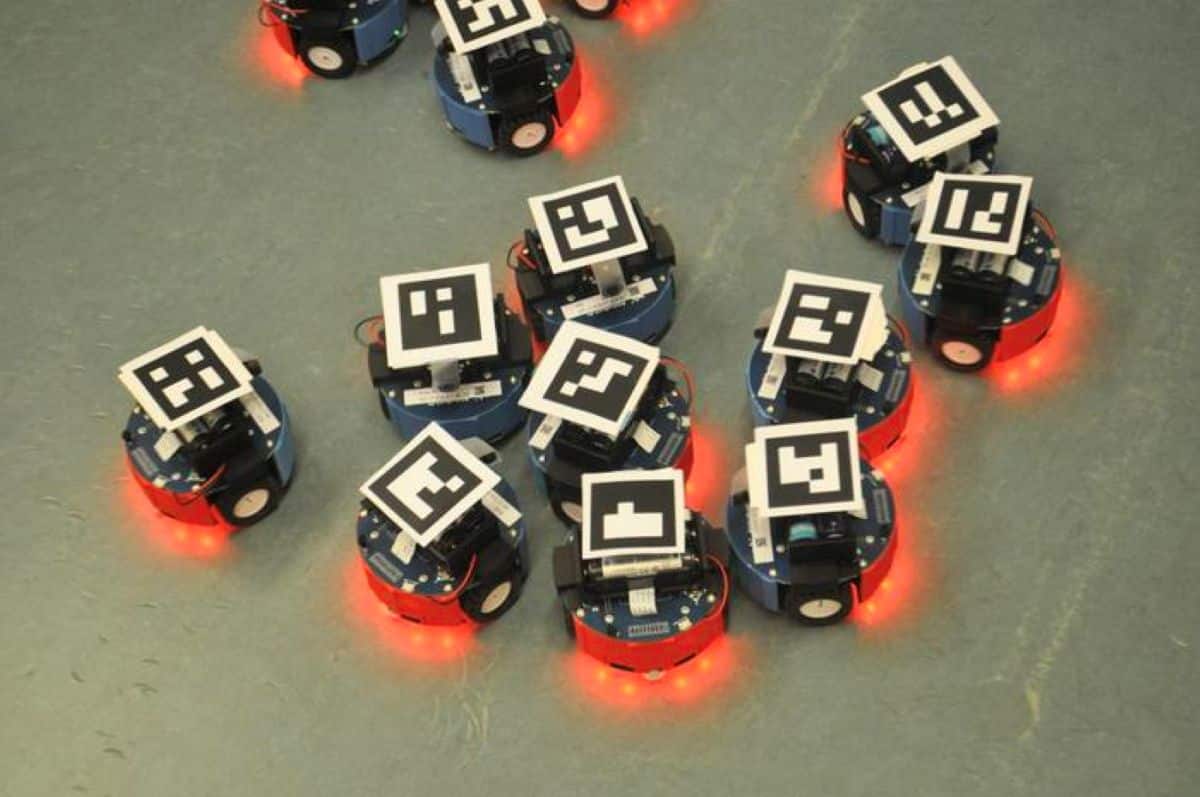
To check whether or not their concepts would play out within the bodily world, Liu and the crew collaborated with physicist Federico Toschi at Eindhoven College of Know-how within the Netherlands, the place Liu helped arrange swarms of small, wheeled robots in a lab outfitted with an overhead digital camera.
Every robotic carried a QR code so the digital camera might monitor their positions and assist them get re-assigned to new positions. Whereas the robots turned and moved extra slowly and imperfectly than within the laptop simulations, the important thing emergent behaviors continued.
The research confirmed a core theoretical perception: A strong central laptop or ultra-intelligent robots aren’t obligatory to attain coordinated duties. A easy native set of navigational guidelines, no less than as much as sure densities, could also be all you want.
“Understanding how energetic matter, whether or not it’s a swarm of ants, a herd of animals, or a bunch of robots, turn into useful and execute duties in crowded environments utilizing the rules of self-organization, is related to many questions in behavioral ecology,” Mahadevan stated. “Our research suggests methods which may properly be a lot broader than the instantiation we’ve centered on.”
Liu stated she has all the time been drawn to analysis that focuses on the secure design of extremely trafficked areas. The research hints at a future the place crowd dynamics could possibly be mathematically predicted and tuned – whether or not the cooks within the kitchen are people, robots, automobiles, or a mixture of all.
Funding: Funding for the analysis got here from the Nationwide Science Basis Graduate Analysis Fellowship Program underneath Grant No. DGE 2140743, together with grants from the Simons Basis and the Henri Seydoux Fund.
Key Questions Answered:
A: It’s not about being aimless; it’s about being “slippery.” In a crowded house, a robotic that solely strikes in a straight line is a brick wall to others. A robotic with slightly “wiggle” can pivot and slide round obstacles, turning a everlasting visitors jam right into a fluid, transferring crowd.
A: Precisely. The research means that “native guidelines” are sometimes higher than “central management.” As a substitute of an enormous laptop making an attempt to calculate 1,000 completely different paths, you simply give every robotic a tiny little bit of random motion, and the physics of the group does the remainder of the be just right for you.
A: That’s the purpose! The researchers consider these formulation apply to any “energetic matter.” By understanding the maths of crowd density and “wiggle room,” architects might design areas that naturally nudge folks into the “Goldilocks zone” of motion, stopping harmful crushes and delays.
Editorial Notes:
- This text was edited by a Neuroscience Information editor.
- Journal paper reviewed in full.
- Extra context added by our employees.
About this robotics and neurotech analysis information
Writer: Anne Manning
Supply: Harvard
Contact: Anne Manning – Harvard
Picture: The picture is credited to Lucy Liu / Harvard SEAS
Authentic Analysis: Closed entry.
“Noise-enabled purpose attainment in crowded collectives” by Lucy Liu, Justin Werfel, Federico Toschi, and L. Mahadevan. PNAS
DOI:10.1073/pnas.2519032123
Summary
Noise-enabled purpose attainment in crowded collectives
In crowded environments, people should navigate round different occupants to succeed in their locations. Understanding and controlling visitors flows in these areas is related for coordinating robotic swarms and designing infrastructure for dense populations.
Right here, we use simulations, idea, and experiments to check how including stochasticity to agent movement can scale back visitors jams and assist brokers journey extra rapidly to prescribed objectives. A computational strategy reveals the collective conduct.
Above a vital noise stage, giant jams don’t persist. From this commentary, we analytically approximate the swarm’s purpose attainment charge, which permits us to resolve for the agent density and noise stage that maximize the objectives reached.
Robotic experiments corroborate the behaviors noticed in our simulated and theoretical outcomes. Lastly, we evaluate easy, native navigation approaches with a complicated however computationally pricey central planner.
A easy reactive scheme performs properly as much as reasonable densities and is way extra computationally environment friendly than a planner, motivating additional analysis into strong, decentralized navigation strategies for crowded environments.
By integrating concepts from physics and engineering utilizing simulations, idea, and experiments, our work identifies new instructions for emergent visitors analysis.