

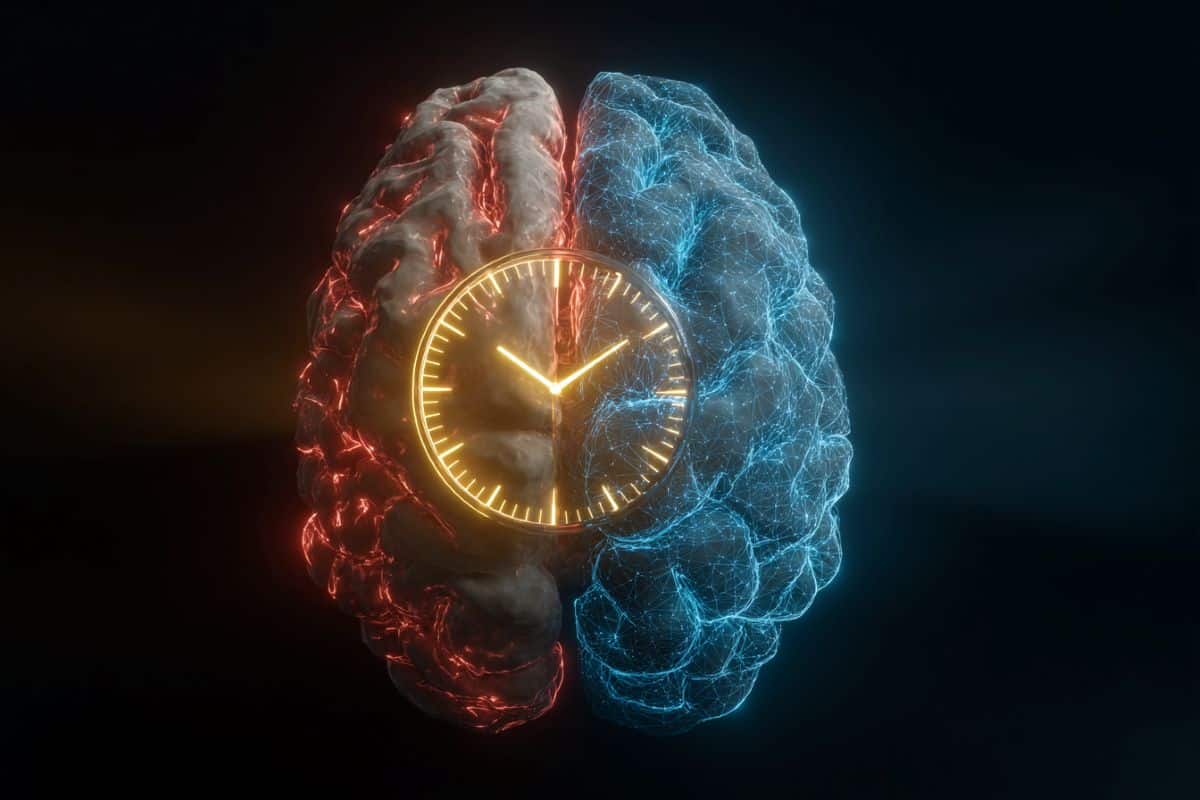
Abstract: True psychological resilience isn’t about how “robust” you might be within the warmth of the second—it’s about how your mind reorganizes itself as soon as the hazard has handed. A groundbreaking research has recognized a particular “resilience window” that peaks roughly 60 minutes after a demanding occasion.
The analysis used simultaneous fMRI and EEG to indicate that whereas bodily signs like coronary heart fee return to regular shortly, the mind’s high-level restoration—shifting from “alarm mode” to “reflection mode”—takes a full hour to manifest.
Key Details
- The One-Hour Mark: Researchers discovered that particular person variations in resilience had been finest predicted by mind exercise 60 minutes post-stress, moderately than the quick response to the stressor itself.
- Community Handover: Resilient people confirmed a definite shift: a lower within the Salience Community (risk detection) and a rise within the Default Mode Community (inside reflection and processing).
- EEG “Cool Down”: A big drop in high-beta EEG energy—a marker of neural arousal—was noticed in resilient members on the one-hour mark, signaling a profitable “settling” of the nervous system.
- Scientific Timing: This “window” gives a particular timeframe for interventions. Scientists recommend that remedy or mind stimulation delivered precisely one hour after a trauma might “nudge” the mind towards a extra resilient state.
Supply: Kochi College of Know-how
Psychological resilience is usually misunderstood as easy “toughness” or an insensitivity to emphasize. Nonetheless, true resilience is the mind’s capability to adapt and get well after a demanding occasion.
Researchers from the Kochi College of Know-how (KUT) and the Shizuoka Institute of Science and Know-how (SIST) have found that this restoration course of doesn’t peak instantly; as an alternative, it manifests in a definite “resilience window” about an hour later.

Printed within the Proceedings of the Nationwide Academy of Sciences (PNAS), the research utilizing simultaneous fMRI and EEG revises long-standing assumptions about neural restoration and identifies a targetable timeframe for scientific and academic interventions.
Capturing the “Unfolding” Mind
The workforce tracked roughly 100 adults following an acute stressor (a cold-pressor take a look at). Whereas peripheral stress indicators like coronary heart fee and cortisol ranges returned to baseline comparatively shortly, fMRI and EEG revealed that the mind’s high-order reorganization was solely simply starting.
“Most resilience analysis depends on animal fashions, defining it because the absence of depression-like conduct,” explains Dr. Noriya Watanabe, the research’s initiator. “However human resilience is extra advanced. It entails self-efficacy and previous expertise—issues you’ll be able to’t ask a mouse in an interview. To grasp these higher-order mechanisms, we needed to research the human mind immediately because it adapts.”
A Shift in Networks
The researchers discovered that about 60 minutes post-stress, resilient people—quantified by validated psychological scales—confirmed a big shift: a lower in salience-network exercise (related to alarm and risk detection) and a rise in default-mode community activation (related to inside reflection). This was accompanied by a marked fall in high-beta EEG energy, an indicator of settling neural arousal.
“By the one-hour mark, whereas bodily signs of stress had vanished, nonconscious mind modifications had been nonetheless unfolding,” says Dr. Masaki Takeda, senior writer of the research. “This particular timing defined particular person variations in resilience much better than any quick response.”
Precision Timing for Psychological Well being
Figuring out this one-hour window gives a roadmap for “time-sensitive” care. Transient psychological assist or non-invasive mind stimulation could possibly be synchronized with this pure window to “nudge” the mind towards a resilient state.
Past quick stress, these neural signatures might function biomarkers for PTSD and melancholy. By offering goal numbers, the research permits clinicians to gauge a affected person’s pure restoration capability and ship assist when the mind is most receptive to vary.
Key Questions Answered:
A: Bodily, perhaps—however neurologically, the work is simply beginning. This research exhibits that even after your coronary heart stops racing, your mind continues to be “unfolding” its restoration. Essentially the most crucial modifications in your neural networks don’t even peak till an hour after the stressor is gone.
A: Consider the Salience Community as your mind’s “fireplace alarm.” It’s nice for recognizing hazard, however you’ll be able to’t stay in that state. The Default Mode Community is your “dwelling base.” Resilient persons are higher at turning off the alarm and returning to that reflective, calm dwelling base as soon as the risk has handed.
A: Doubtlessly! Because the mind is most “receptive” to reorganization about an hour after stress, that may be the proper time for a mindfulness session, a supportive speak with a buddy, or deep respiration. You’re basically “syncing” your self-care together with your mind’s pure restoration window.
Editorial Notes:
- This text was edited by a Neuroscience Information editor.
- Journal paper reviewed in full.
- Further context added by our employees.
About this psychology analysis information
Creator: Masaki Takeda
Supply: Kochi College of Know-how
Contact: Masaki Takeda – Kochi College of Know-how
Picture: The picture is credited to Neuroscience Information
Unique Analysis: Closed entry.
“Neural signatures of human psychological resilience pushed by acute stress” by Noriya Watanabe, Shinichi Yoshida, Ruedeerat Keerativittayayut, and Masaki Takeda. PNAS
DOI:10.1073/pnas.2524075123
Summary
Neural signatures of human psychological resilience pushed by acute stress
Neurophysiological mechanisms underlying psychological resilience—the power to beat adversity—have been extensively studied in animals. Nonetheless, in comparison with that in animals, human resilience is exclusive in that it’s underpinned by higher-order cognitive capabilities, corresponding to self-confidence, tenacity, and a optimistic perspective to challenges.
Given these discrepancies, the neurophysiological mechanisms underlying human-specific resilience stay unclear.
To handle this concern, we aimed to report multimodal responses after acute stress publicity over 1.5 h utilizing useful mind imaging and peripheral physiological measurements. We confirmed that the diploma of particular person resilience is listed by a number of modifications in neural dynamics 1 h after acute stress.
Useful magnetic resonance imaging and electroencephalography present that exercise within the cortical salience community and energy in high-beta and gamma oscillations improve in much less resilient people. Contrastingly, exercise within the cortical default mode community and spontaneous exercise within the posterior hippocampus improve in additional resilient people.
Machine studying evaluation confirmed that, 1 h after stress publicity, the useful connectivity within the salience community was probably the most influential, adopted by that within the default mode community, gamma energy, high-beta energy, and hippocampal exercise. The neurophysiological dynamics for resilience don’t happen as beforehand thought, however moderately in a time-lagged method towards stress publicity.
Our findings make clear an method to restoration from stress-induced deficits corresponding to delayed neuromodulation after a demanding occasion.



