

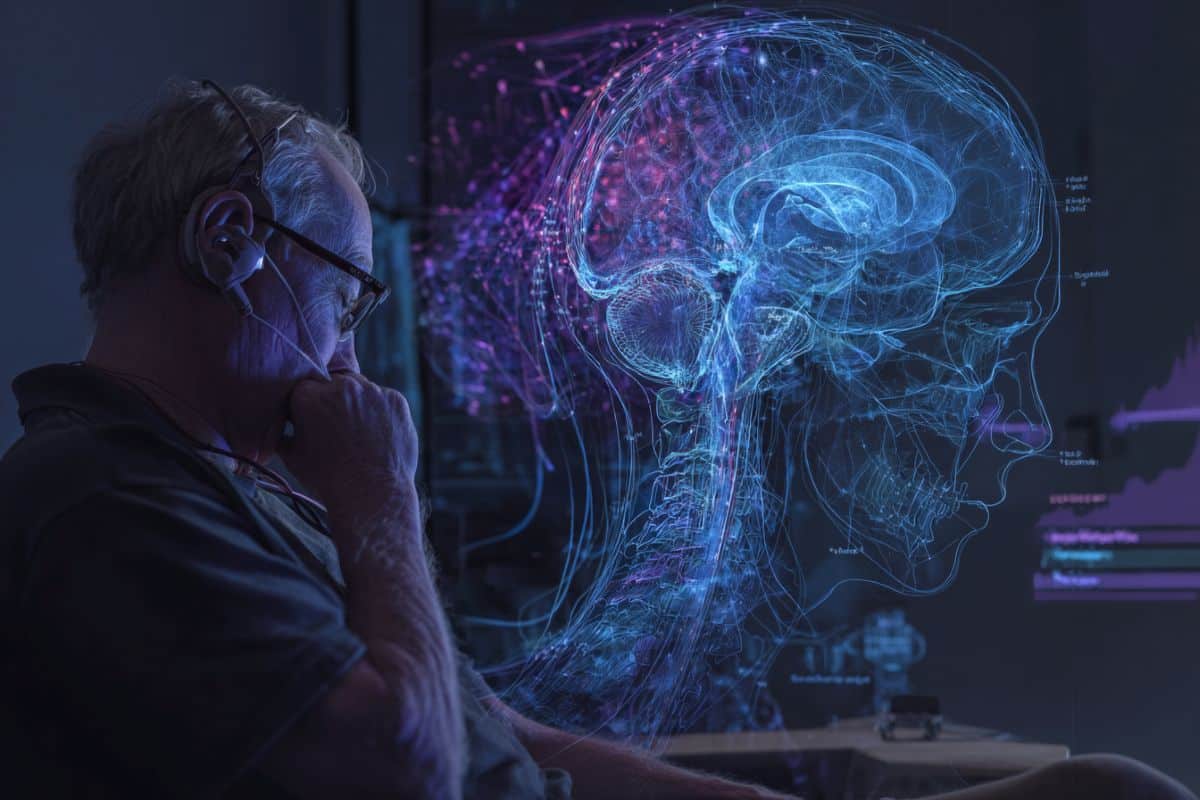
Abstract: A brand new examine evaluating stroke survivors with wholesome adults reveals that post-stroke language issues stem not from slower listening to however from weaker integration of speech sounds. Whereas sufferers detected sounds as shortly as controls, their brains processed speech options with far much less power, particularly when phrases have been unclear.
Wholesome listeners prolonged processing throughout uncertainty, however stroke survivors didn’t, suggesting they could abandon sound evaluation too early to totally grasp tough phrases. The findings spotlight neural patterns important for verbal comprehension and level to sooner, story-based diagnostic instruments for language impairments.
Key Information
- Weakened Integration: Stroke survivors course of speech sound options with a lot decrease neural power regardless of regular sound detection pace.
- Decreased Persistence: When phrases are unclear, they don’t maintain processing lengthy sufficient to resolve ambiguity.
- Diagnostic Potential: Easy story-listening duties could substitute prolonged behavioral assessments for language issues.
Supply: SfN
Following stroke, some individuals expertise a language dysfunction that hinders their means to course of speech sounds. How do their brains change from stroke?
Researchers led by Laura Gwilliams, school scholar on the Wu Tsai Neuroscience Institute and Stanford Knowledge Science and assistant professor at the Stanford College of Humanities and Sciences, and Maaike Vandermosten, affiliate professor on the Division of Neurosciences at KU Leuven, in contrast the brains of 39 sufferers following stroke and 24 wholesome age-matched controls to unveil language processing mind mechanisms.

As reported of their Journal of Neuroscience paper, the researchers recorded mind exercise whereas volunteers listened to a narrative.
Folks with verbal speech processing points from stroke weren’t slower to course of speech sounds however had a lot weaker processing than wholesome members.
In accordance with the researchers, this means that individuals with this language dysfunction can hear sounds of all types in addition to wholesome individuals however have points integrating speech sounds to perceive language.
Moreover, when there was uncertainty about what phrases have been being mentioned, wholesome individuals processed speech sound options longer in comparison with those that had skilled a stroke.
This may imply that, following stroke, individuals don’t course of speech sounds lengthy sufficient to efficiently comprehend phrases which might be tough to detect.
This work factors to mind exercise patterns that could be essential for understanding verbal language, in keeping with the authors.
First creator Jill Kries expresses pleasure about persevering with to discover how this easy method—listening to a narrative—can be utilized to enhance diagnostics for situations characterised by language processing points, which at present contain hours of behavioral duties.
Key Questions Answered:
A: Their brains detect sounds usually however combine speech options with decreased power, making comprehension tougher even when listening to is unbroken.
A: Wholesome listeners course of sound options longer to resolve ambiguity, however stroke survivors cease too quickly, resulting in missed that means.
A: Story-listening mind recordings could present a fast, naturalistic various to hours of behavioral language testing.
Editorial Notes:
- This text was edited by a Neuroscience Information editor.
- Journal paper reviewed in full.
- Further context added by our employees.
About this stroke and speech processing analysis information
Creator: SfN Media
Supply: SfN
Contact: SfN Media – SfN
Picture: The picture is credited to Neuroscience Information
Unique Analysis: Closed entry.
“The Spatio-Temporal Dynamics of Phoneme Encoding in Growing old and Aphasia” by Laura Gwilliams et al. Journal of Neuroscience
Summary
The Spatio-Temporal Dynamics of Phoneme Encoding in Growing old and Aphasia
Throughout profitable language comprehension, speech sounds (phonemes) are encoded inside a sequence of neural patterns that evolve over time.
Right here we examined whether or not these neural dynamics of speech encoding are altered for people with a language dysfunction. We recorded EEG responses from human brains of 39 people with post-stroke aphasia (13♀/26♂) and 24 wholesome age-matched controls (i.e., older adults; 8♀/16♂) throughout 25 minutes of pure story listening.
We estimated the period of phonetic characteristic encoding, pace of evolution throughout neural populations, and the spatial location of encoding over EEG sensors.
First, we set up that phonetic options are robustly encoded in EEG responses of wholesome older adults.
Second, when evaluating people with aphasia to wholesome controls, we discover considerably decreased phonetic encoding within the aphasic group after shared preliminary processing sample (0.08-0.25s after phoneme onset).
Phonetic options have been much less strongly encoded over left-lateralized electrodes within the aphasia group in comparison with controls, with no distinction in pace of neural sample evolution.
Lastly, we noticed that wholesome controls, however not people with aphasia, encode phonetic options longer when uncertainty about phrase id is excessive, indicating that this mechanism – encoding phonetic data till phrase id is resolved – is essential for profitable comprehension.
Collectively, our outcomes recommend that aphasia could entail failure to keep up lower-order data lengthy sufficient to acknowledge lexical gadgets.



