
Image this: a frazzled guardian sorts “Plan my child’s party underneath $300” into ChatGPT. Inside seconds, they’ve received a theme, a provide record, and hyperlinks to purchase all the pieces — cake topper, streamers, social gathering favors, and baggage — with out ever typing a URL or touchdown on a homepage.
In the meantime, a 20-something scrolling TikTok at 11 p.m. watches a creator demo a skincare routine, faucets “purchase,” and has three merchandise headed to their door earlier than the video ends.
These are hardly hypotheticals anymore.

TikTok Store hit $33.2 billion in world gross merchandise worth (GMV) in 2024, with $9 billion from the U.S. alone: a 650% year-over-year explosion simply 16 months after launch. The broader U.S. social commerce market has already reached $114.7 billion in 2025. And Morgan Stanley predicts that just about half of U.S. internet buyers shall be utilizing AI purchasing brokers by 2030, probably including $115 billion to e-commerce.
When you’re a service provider studying these numbers, you would possibly really feel the bottom shifting beneath your rigorously optimized product pages. Must you abandon your web site and go all-in on social? Is your homepage about to turn out to be as related as a telephone e book?
Properly, right here’s the place issues get fascinating. DreamHost’s Native Enterprise Belief Index discovered that customers are 7x extra snug making purchases of $100 or extra on an organization’s web site than by way of social media platforms. They’re additionally 14x extra prone to spend $500+ on a web site.
And their common snug spending quantity? Simply $36 on social platforms, versus $177 on a web site.
So no, your web site isn’t lifeless, nevertheless it is perhaps altering jobs. Let’s unpack what’s taking place and what it means on your on-line storefront.
Two forces are reshaping how folks purchase issues on-line: the explosive progress of social commerce and the emergence of AI purchasing brokers. Collectively, they’re making a world the place your subsequent buyer would possibly uncover, consider, and even buy merchandise with out ever deliberately visiting your web site.
However there’s a persistent belief hole that retains your owned digital presence extra related than ever.
How Social Commerce and AI Brokers Are Rewriting the Funnel
The numbers present a elementary shift in the place commerce occurs. Whereas social commerce has been rising for years, AI purchasing brokers signify one thing newer, and probably much more disruptive. On Black Friday 2025, AI-driven site visitors to U.S. retail websites surged 805% year-over-year, serving to drive $11.8 billion in on-line spending, a brand new report.
The sensible implications are important. ChatGPT already has a Shopify integration for in-chat purchases. Amazon’s Rufus, Walmart’s Sparky, and Goal’s ChatGPT integration are making AI-assisted purchasing really feel as pure as asking a retailer affiliate for assist.
Plus, AI browsers, like Perplexity’s Comet, let customers drop in a grocery record and have the AI add all the pieces to their cart mechanically.
Discovery, comparability, and more and more even checkout are taking place inside platforms and AI assistants — not in your homepage. However that’s solely half the story.
The Belief Hole: Large Purchases Nonetheless Occur on Web sites
For all the joy round social commerce and AI brokers, there’s a elementary asymmetry in the place persons are keen to spend critical cash.
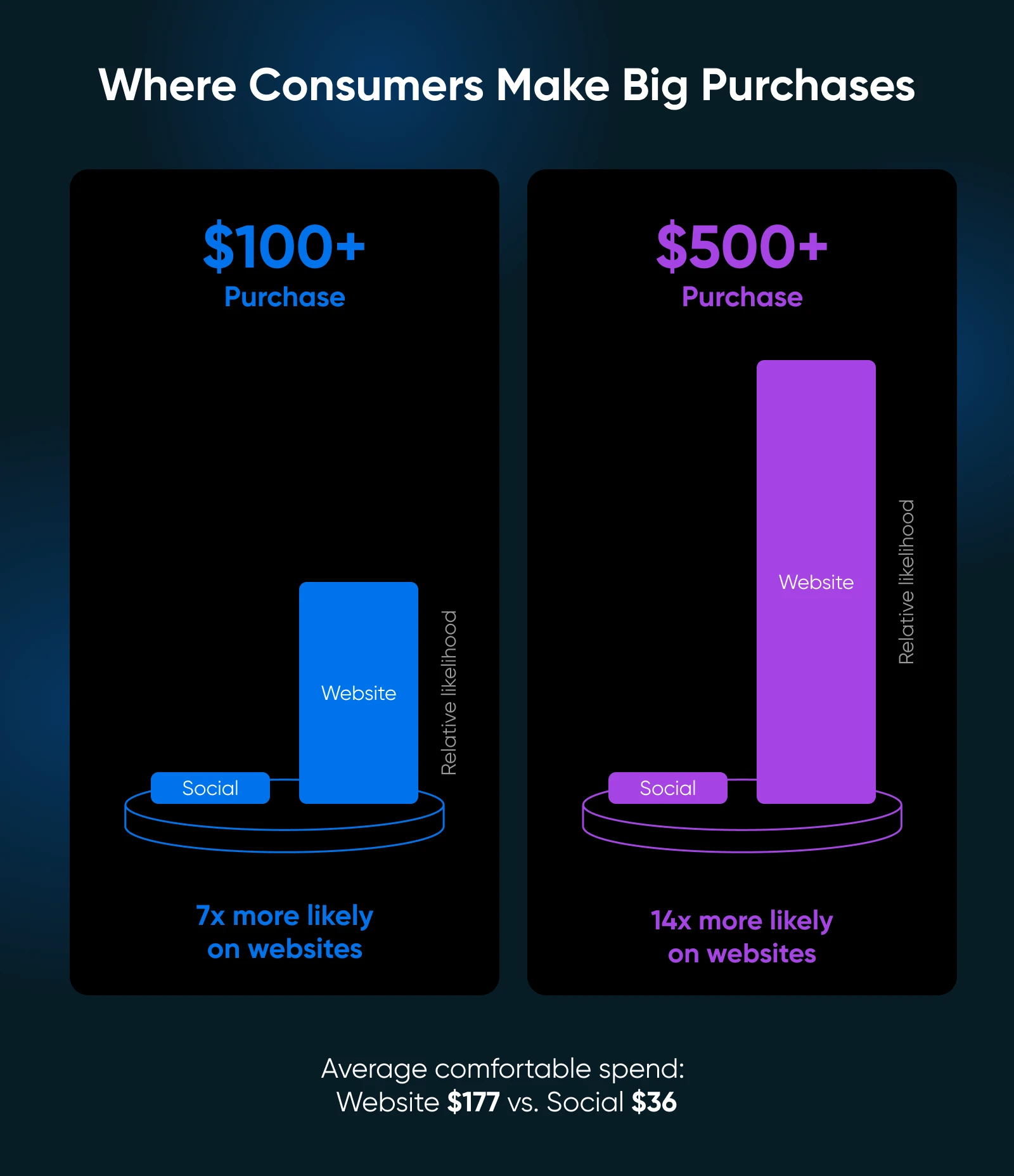
Once we performed our Belief Index survey in November, our findings had been placing:
- Shoppers are 7x extra snug making high-value purchases ($100+) on an organization’s web site than by way of social media platforms.
- They’re 14x extra prone to spend $500+ on a web site versus social.
- Common spend consolation is simply $36 by way of social media versus $177 by way of a enterprise web site.
- 33% of respondents mentioned they wouldn’t really feel snug spending any cash by way of social media.
Social platforms are optimized for leisure and discovery, not for detailed product data, clear return insurance policies, and model credibility alerts that individuals want earlier than making important purchases.
What does this imply for retailers? Platforms excel at getting you seen, however your web site remains to be the place critical spending and long-term belief dwell.
3 Shifts That Truly Matter for Your Retailer
If you lower by way of the noise, we see three shifts that can really form the way you promote on-line within the subsequent few years.
Shift #1: Social Commerce Turns into the Impulse Layer
Consider social commerce as window purchasing on steroids, particularly for Gen Z and youthful millennials. The format rewards scrolling, discovery, and split-second buy choices. You see one thing fascinating in a 30-second video, you faucet purchase, it exhibits up in three days —the friction between “that appears cool” and “I personal it” has basically disappeared.
The platform isn’t changing conventional e-commerce, nevertheless it is creating a brand new class: the ambient, entertainment-driven impulse purchase.
👉What it means for e-commerce retailers: Use TikTok and Instagram as discovery engines and low-friction checkout factors for merchandise underneath $50: bundles, restricted drops, trending objects. That is your impulse shelf.
For higher-value objects, use social content material strategically to nudge folks again to your web site, the place they’ll discover your complete model story, detailed product specs, transport insurance policies, and genuine buyer opinions.
Shift #2: AI Buying Brokers Turn out to be Your Buyer’s Private Purchaser
AI purchasing brokers are basically digital private customers that may observe directions, keep on with budgets, examine choices throughout a number of retailers, and even full checkout. They’re transferring from novelty to infrastructure sooner than many retailers understand.
The most important gamers are already out there: ChatGPT with Shopify integration, Amazon’s Rufus, Walmart’s Sparky, Goal’s ChatGPT integration, and devoted AI browsers like Perplexity’s Comet. These instruments can create grocery lists, analysis merchandise, examine costs, and mechanically add objects to carts.
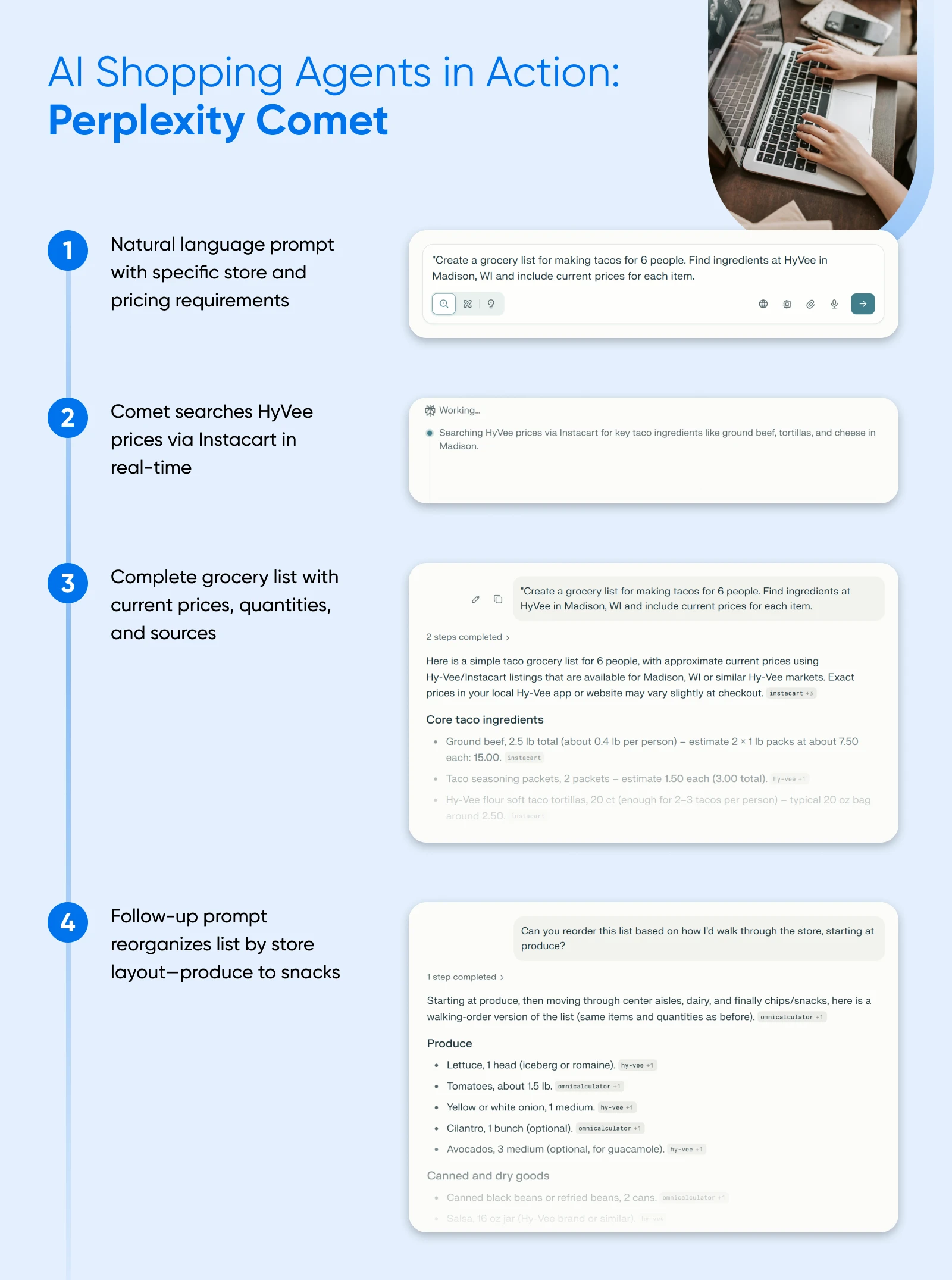
AI brokers aren’t making emotional choices or responding to flashy graphics. They’re optimizing for particular standards. Right here’s how brokers select which merchandise to suggest:
- Structured product knowledge: Clear titles, full attributes, correct specs.
- Clear pricing: No hidden prices, clear transport charges, trustworthy complete price.
- Clear return insurance policies: Brokers want to have the ability to talk phrases to customers.
- Stock accuracy: Nothing frustrates an AI agent like recommending out-of-stock objects.
- Reliability alerts: Brokers “be taught” which shops ship what they promise.
👉What it means for e-commerce retailers: Make your catalog machine-readablewith particular consideration to your knowledge hygiene. Fill in product attributes persistently (supplies, sizing, compatibility), use descriptive, trustworthy product titles, add structured knowledge/schema markup, and reply frequent questions instantly on product pages so AI has one thing reliable to cite.
Shift #3: Commerce Strikes Into Browsers and Tremendous-Apps
AI-native browsers and OS-level assistants are making commerce really feel like a dialog moderately than a vacation spot. Comet lets customers create a grocery record and have the AI add objects to their Instacart cart mechanically. OpenAI’s Atlas browser is constructed across the similar premise: inform it what you want, and it handles the purchasing.
In the meantime, retailer assistants like Rufus, Walmart’s AI instruments, and Goal’s ChatGPT integration are making checkout really feel like one faucet from anyplace. The boundary between “shopping the web” and “purchasing” is dissolving.
👉What it means for e-commerce retailers: Prospects would possibly first encounter your model inside another person’s interface, like an AI chat, a voice assistant, or a browser sidebar. This modifications what they see first, however not what issues:
- Model consistency: Your title, visuals, and positioning should be recognizable when somebody clicks by way of from an AI advice.
- Web site efficiency: In case your web page masses slowly after somebody arrives from a seamless AI expertise, they’ll bounce.
- The vacation spot expertise: AI can suggest you, however your web site closes the sale.
The place Your Web site Matches: The Belief, Information, and Relationship Layer
In gentle of all of this, do it’s worthwhile to reframe what your web site really does?
Possibly.
Your web site is not simply an “on-line retailer”. Now, it’s the supply of reality for all the pieces else in your commerce ecosystem.
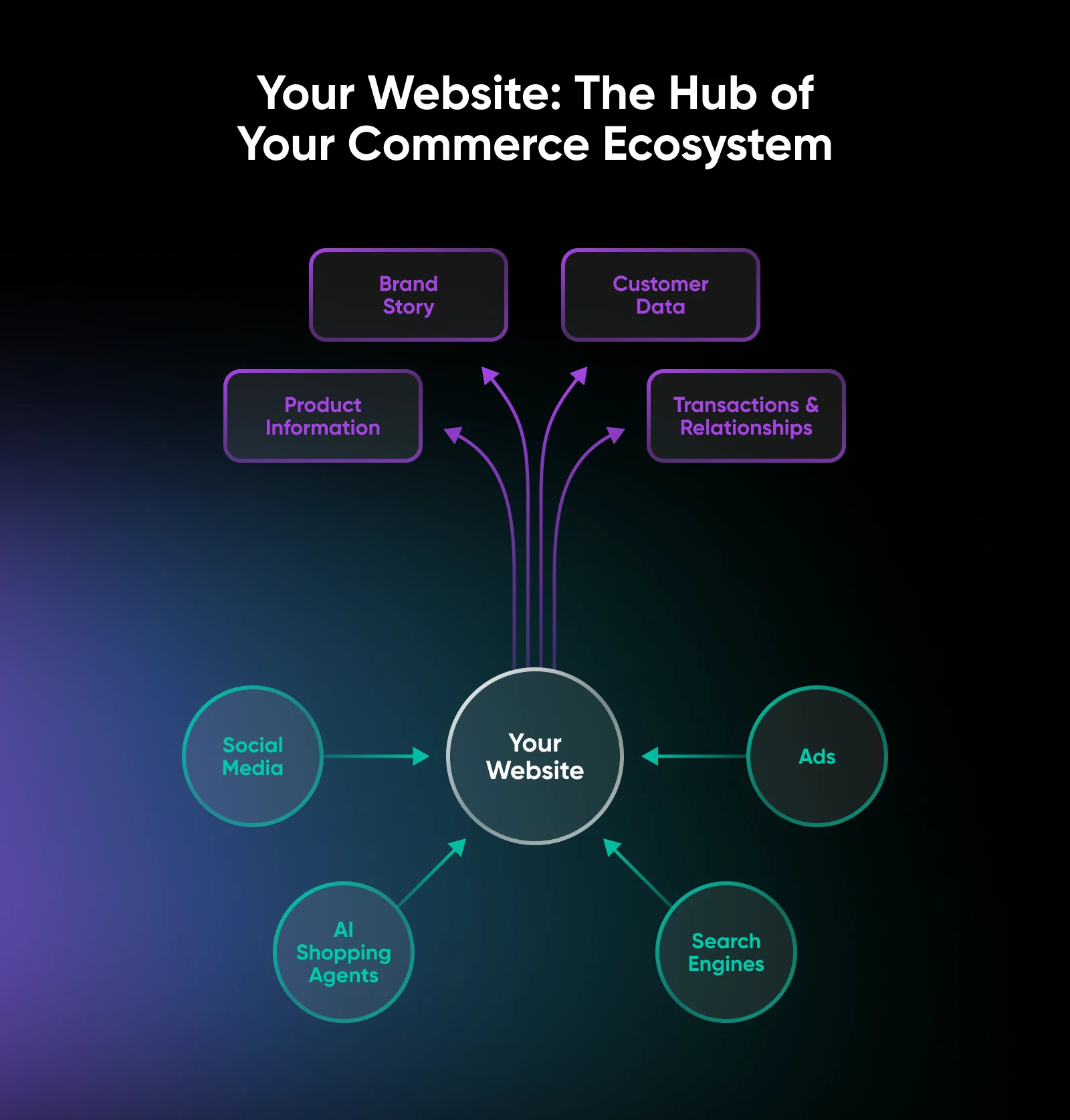
Product Data and Insurance policies
Your web site is the authoritative reply to each query an AI agent, comparability shopper, or cautious purchaser would possibly ask.
Supplies? Dimensions? Return window? Guarantee? When an AI is deciding whether or not to suggest your product, it’s pulling out of your product pages. When a buyer is deciding whether or not $200 is value it, they’re checking your web site for reassurance.
Model Story and Social Proof
Social platforms and AI brokers can introduce folks to your model. Your web site is the place they arrive to validate what they found.
Buyer opinions, testimonials, your origin story, your values — these dwell in your web site.
Owned Buyer Information
This is perhaps a very powerful perform of all. When somebody buys by way of TikTok Store or an AI agent’s advice, you get a transaction. After they purchase by way of your web site, you get a relationship: e-mail addresses, buy historical past, preferences, and shopping conduct.
That is knowledge no platform can take away, and no algorithm change can erase.
Large-ticket purchases and long-term relationships nonetheless consolidate on web sites. Social and AI channels are discovery mechanisms; your web site is the place dedication occurs, and you may map your complete buyer journey.
At DreamHost, we’ve been championing web site possession for over 27 years. Proudly owning your web site is the way you keep management of your model, knowledge, and margins whereas the remainder of the web experiments with new methods to buy, and whereas the web turns into more and more subscription-based, we’re advocating greater than ever for the open net.
A Framework for E-Commerce Retailers within the AI Age
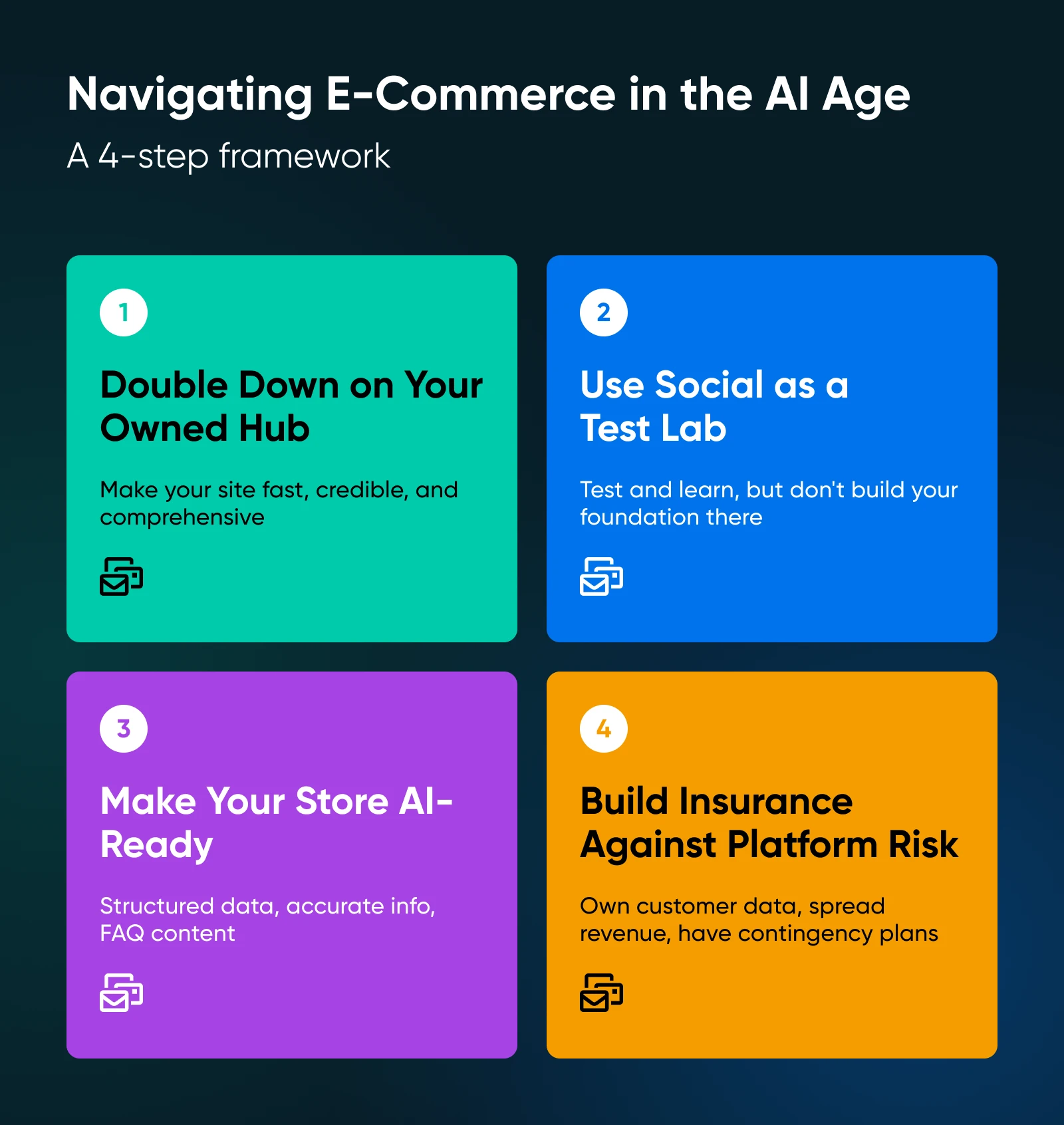
So how ought to e-commerce retailers navigate this new panorama because it emerges? Right here’s a four-step framework you should use.
1. Double Down on Your Owned Hub
Earlier than chasing new channels, be certain that your basis is strong. Make your web site the strongest model of itself: quick, mobile-friendly, and clear. Add opinions. Publish detailed insurance policies. Present content material that solutions questions earlier than customers ask them.
Every enchancment compounds your belief benefit, and helps each people and algorithms see your retailer as credible.
2. Use Social as a Check Lab, Not Your Basis
The worry of lacking out on TikTok Store or Instagram Buying is actual. However the retailers who succeed with social commerce deal with it strategically.
Decide one or two platforms the place your viewers already lives. Check product angles, creator partnerships, bundles, and worth factors. Let social provide you with speedy client perception, however don’t depend on it for long-term stability.
3. Make Your Retailer AI-Prepared
Getting ready your retailer for AI purchasing brokers doesn’t require technical experience. It requires self-discipline and consistency.
- Fill in product attributes persistently: Supplies, sizing, compatibility, care directions.
- Use descriptive, trustworthy product titles: No key phrase stuffing, no deceptive descriptions.
- Add structured knowledge and schema markup: Product schema, overview schema, and FAQ schema — all assist AI instruments suggest your merchandise.
- Hold stock and pricing correct: Replace in real-time if doable, or each day at a minimal.
- Embody FAQ content material on product pages: This offers AI brokers content material to cite when making suggestions.
Consider it as giving AI a clear transcript of your retailer, so brokers can perceive and signify your merchandise precisely.
4. Construct Insurance coverage Towards Platform Danger
When you’ve been in e-commerce for various years, you’ve seen platforms change their guidelines in a single day. Algorithm updates, coverage shifts, regulatory uncertainty — any single channel can turn out to be unreliable with little warning.
Right here’s learn how to shield your self:
- All the time gather e-mail and SMS by yourself web site: That is buyer knowledge you personal.
- Unfold income throughout a number of channels: If greater than 40% of your income comes from any single exterior channel, you’re uncovered.
- Doc channel efficiency rigorously: Know your metrics by channel so you possibly can pull again shortly if one thing modifications.
- Have a contingency plan: What occurs if TikTok will get banned tomorrow? Know your strikes earlier than it’s worthwhile to make them.
Guardrails for Evaluating “The Subsequent Large Factor”
Each few months, there’s a brand new platform, a brand new AI integration, a brand new commerce channel that everybody insists it’s worthwhile to be on instantly or threat irrelevance. Right here’s a guidelines for reducing by way of the hype.
Earlier than leaping on any new platform or software, ask your self:
- Does this assist me attain my precise clients? Not simply “folks,” your folks. Those who really purchase what you promote.
- Can I get knowledge out of it and produce folks again to my web site? When you can’t seize emails or re-target guests, you’re constructing on rented land with no deed.
- What occurs if this platform disappears tomorrow? Ask Vine creators how that labored out.
- Do I perceive the way it handles my clients’ knowledge? Privateness considerations translate on to belief considerations.
- Can I run this as a time-boxed experiment? Each new channel ought to have a speculation, a funds, and a deadline — not a without end dedication primarily based on FOMO.
The retailers who thrive in quickly altering environments aren’t those who chase each development. They’re those who take a look at intelligently, measure truthfully, and know when to double down versus when to stroll away.
The Way forward for E-Commerce Isn’t Web site vs. Platform: It’s How You Orchestrate Each
AI brokers and social commerce will more and more deal with discovery and low-friction purchases. That’s not a risk — it’s a distribution alternative. New channels imply new methods for purchasers to search out you, new moments to seize consideration, and new paths to buy.
However web sites stay the belief anchor, the info supply, and the place the place actual buyer relationships dwell. When somebody’s deciding whether or not to spend $200, they’re not doing it in a TikTok remark part. After they need to perceive your model, learn opinions from folks like them, or know precisely what they’re getting — they arrive to your web site.
Proudly owning your web site isn’t about resisting change. It’s about having a house base whilst you discover what’s subsequent — conserving management of your model, knowledge, and margins whereas the remainder of the web experiments with new methods to buy.

Set Your Retailer Up For Success
Promote something, anyplace, anytime on the world’s largest on-line retailer platform.
Did you take pleasure in this text?